UNDER CONSTRUCTION
New website launching soon.
Stay tuned
Launching in:
© IVA SINTIC // 2026
UNDER CONSTRUCTION
New website launching soon.
Stay tuned
Launching in:
© IVA SINTIC // 2026
Iva Šintić and Clémentine Muller – www.clementine-mu.cargo.site
2023 – ongoing
Collective ALICE is assembled around research into the materials of celestial bodies and the possibilities they hold for human habitats beyond Earth. Our research framework is based on the collection and analysis of chemical compositions and the heat transformation of simulants, with the Moon as the primary focus of our first study. To meet the challenge of transforming matter and generating colour, we link the characteristics of lunar regolith with knowledge and protocols from the field of ceramics.
For most people, the Moon embodies a grey mass, seemingly devoid of the diversity of colours we take for granted on Earth. As artists, we question the chromatic range that will shape this future habitat, aware of the central role of colour in our daily lives.
When I move to the Moon, I will paint my rooms blue. I will paint my cups yellow and bring the green with me. When I move to the Moon, I will steer away from the red and hope you will too.
In 1972, during the Apollo 17 mission, Lunar Module Pilot Harrison Schmitt and Commander Eugene Cernan explored the lunar surface. Amidst the dusty grey expanse, a discovery: orange soil! In a transcript, Cernan confirms: ”He’s not out of his wits. It really is.”
Since then, the colour of this grey pebble has continued to change. Fast development and fairly easy accessibility to technology, which allows us to manipulate and exaggerate its chromatic range, start the shift. We have seen the Moon from Earth covered in many shades, but when one imagines himself standing there, encompassed by its grey expanse, any trace of colour seems like a reason to celebrate.
When I move to the Moon, I will paint my rooms blue, creating a serene environment. This is not an aesthetic choice, but a sensory recalibration, a medium reshaping the environment.
I will bring the green with me, a rhizome of earthly connection, a portable paradise, grounding the desolate expanse. In it, I will look for the essence of life and growth.
I will paint my cups yellow, a daily reminder of soft, gentle light. I will paint each sip with a tactile encounter with warmth and familiarity.
On the Moon, I will avoid red, a sign of danger and blood. Bright red warning signs persist as a symbol of caution embedded in my environmental feedback loop. On the moon, I will avoid ti, and I hope you will too. Let me look for passion elsewhere.
The project presented at the Museum’s temporary gallery is a result of a one-month residency by two artists: Iva Šintić and Simon Burkhalter. The residency is formulated as a work-in-progress laboratory that takes its form around experimentation with different historic tools used in sculpting processes. The two artists use and experiment with the forms of the tools to achieve the different sizes of the objects. By manipulating the size of the objects, they manipulate the sense of space that surrounds us.
Le Labo Bartho, Musée Bartholdi
Résidence d’artiste : Iva Šintić, Simon Burkhalter
18.11.2022 – 31.12.2023
Le projet présenté à la galerie temporaire du Musée est le résultat d’une résidence d’un mois de deux artistes locaux : Iva Šintić et Simon Burkhalter. La résidence est formulée comme un laboratoire de travail en cours qui prend sa forme autour de la experimentation avec différents outils historiques utilisés dans les processus de sculpture. Les deux artistes utilisent et expérimentent les formes des outils pour réaliser les différentes tailles des objets. En manipulant la taille des objets, ils manipulent la sensation d’espace qui nous entoure.

Excerpt from Sometimes Art
(…) Just as we’ve come to dream of falling from skyscrapers, we now carry vivid internal images of fields and particles that were shaped by animations, diagrams, and screens. These visual tools often give us a two-dimensional, schematic representation of something we cannot directly perceive. While they are helpful and serve their purpose, they frequently remain simple graphical abstractions. We are rarely able to translate these abstractions literally into our three- or four-dimensional physical world. Clearly, giving an image to something which has none must be done indirectly, through available tools.
Since this topic of magnetism is not intuitive, I must be aware that the images I carry in my mind all have a source and arrive mostly outside traditional education. Alongside the classical images of magnetic fields, there is an image that stays etched in my mind. It is a colourful animation created by Derek B. Leinweber, showing the gluon fluctuations in a vacuum. This animation was featured in Prof. Frank Wilczek’s 2004 Nobel Prize Lecture, and I must have seen it for the first time not long after that.
The effect of seeing this image was simple and obvious: Is there really no such thing as empty space? What else is hidden in there? And, if one were to take a 20-centimetre cube of space and dissect it in all possible ways, what would one find in there?
For many years, I have held this fictive cube of “nothing” next to me, thinking about what fills it and what it conceals. When I observe it, I imagine a colourful mass of lines and dots, without a clear distinction between different phenomena. Sometimes, I wish to squish it, right before it collapses into a black hole, or count the microscopic elements which I presume I would know to name. More abstract phenomena – particles, waves, and fields always remain lines or points, without a distinct image or name to assign to them.
Now, I wonder how closely those images in my mind match reality. Could I give them a more distinct form, and is it even necessary to do so? (..)
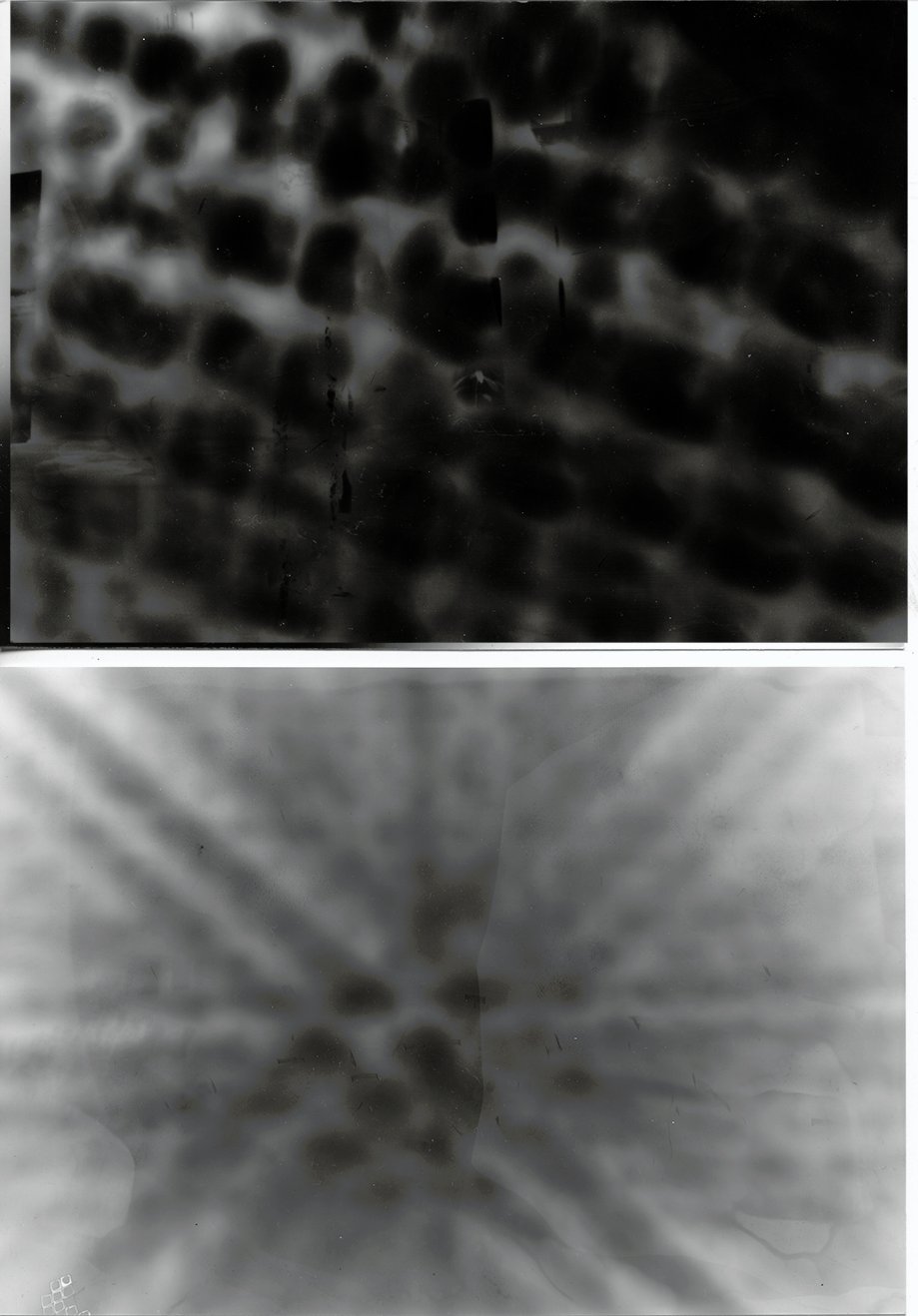
Invisible Forces / Visible Traces
Heiner Franzen – Germaine Sijstermans – Iva Šintić
Städtische Galerie Stapflehus Weil am Rhein
12.06. – 26.07.2026 – https://www.kunstverein-weil.de/kunstverein
CONTEXT
Last year, 2020, I spent for the first time in France without the option of going to Croatia. From March to May, during the first Covid lockdown, we left the house once a day, usually for a walk in the yard, where, like guinea pigs in a cage, we would circle on the 10-metre path to the other side of the garden, from wall to wall. For the second winter lockdown of the same year, we were granted the right to work in the studio. As self-employed, this time we had the right to write “permissions” for ourselves, stating that we could not continue working from home. All events, public and private, in our collective studio were interrupted. Only occasionally would we meet colleagues in the corridor, covered with masks, exchange a few words and close ourselves again in our respective rooms.
I returned to the project Half-half. The redesign of the toothbrush for 2020. Simon and I spent all our time together. I watched how we moved through the flat, trying to pass each other in the corridor, just large enough for one person, and how we spun around the rooms of our small flat. I imagined that we should be wearing sensors, like cats whose movements owners try to record, and that our path from the bathroom to the bed, from the sofa to the kitchen, to the end of the long garden and the furthest path, to the shop, could be traced. I imagined two lines intertwining in space, moments where they touch, moments where they diverge.
I try to define space. I sense when we become nervous, when we forget that the other is somewhere nearby, hidden in front of a screen with headphones, when we still seek time for shared activities. Through the flat’s window, I listen to the neighbours and to the situations unfolding behind closed doors as a result of forced togetherness. Unfortunately, not all stories are positive like ours. In Europe, during the first and second waves of lockdown, domestic violence in some countries rose to unimaginable proportions, while in Croatia, criticism emerged regarding the lack of information and, therefore, lack of support.
We are currently constructing a new studio. Within the same building, we are exchanging 60 m² for approximately 180 m². We are constructing smaller rooms on two floors and dividing the space. Between our newly built studios, we will put a wall: you play here, and I play here
OBJECT
I reflect on the redesign of the toothbrush for 2020. The toothbrush for two is an absurd object, created as a by-product of failed attempts to define space. The toothbrush is an intimate object that, when shared by two people, places them in a position of intimacy at a level we are often not prepared to accept. In this case, it becomes a symbol whose meaning lies in the relations between individuals, space, and culture.
The toothbrush, as a symbol, is nothing more than a tool that allows me to speak about seemingly abstract elements through a physical object. Its value lies in the symbolism and in the process, rather than in the finished, absurd product. I decided not to produce any of the models, but to present them exclusively digitally, in accordance with the current condition of gallery exhibitions.
In the previous production of works related to this project, I have dealt with the object and with the idea carried by the object. My interest lies in the definition of space and in the way we share and experience it. Through the redesign of this everyday object, I attempt to define spaces, relations, and movements.